
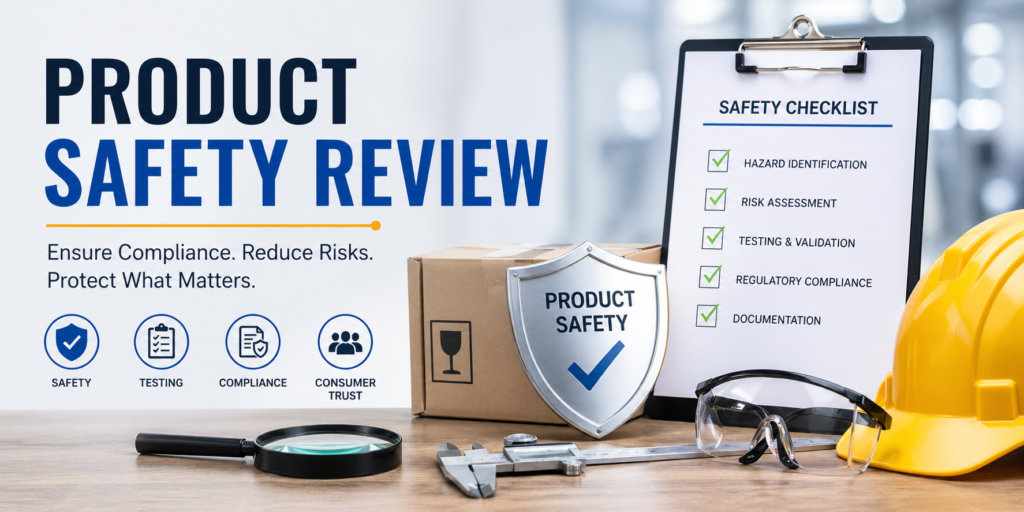

A product safety review is a structured process used to identify risks, verify compliance, and ensure a product is safe before and after it reaches customers.
Simple definition—but the execution? That’s where most brands slip.
I’ve personally led safety reviews for products that looked flawless on paper but failed in real-world use within days. So if you’re here wondering how to actually do this properly, you’re asking the right question.
Let’s break it down in a way that actually helps you apply it.
What Is a Product Safety Review (And Why It Matters)
At its core, a product safety review evaluates whether a product can harm users—physically, chemically, electrically, or even digitally (yes, that’s now a thing). For instance, understanding if a specific digital link like 24ot1jxa is harmful is now as critical as checking physical hardware.”
Here’s the reality most people don’t say out loud:
Passing compliance doesn’t always mean a product is truly safe.
Why this process matters:
- Prevents injuries (and lawsuits that follow)
- Protects your brand reputation long-term
- Ensures you meet legal requirements in different markets
- Reduces risk of product recalls (which are brutally expensive)
I’ve seen one minor design oversight—just a 2mm sharp edge—lead to a full recall. Small details matter more than you think.
Key Components of a Product Safety Review
This isn’t a one-step checklist. It’s layered and iterative.
1. Hazard Identification
We start by mapping everything that could go wrong.
Not just obvious stuff like sharp edges. I’m talking about:
- Heat buildup in enclosed spaces
- Material fatigue over time
- User misuse (kids, elderly, distracted users)
The trick here? Think like a careless user—not an engineer.
2. Risk Assessment
Once hazards are identified, we don’t panic—we prioritize.
We analyze:
- How likely is this to happen?
- If it happens, how bad is it?
For example, a loose screw isn’t always critical. But if it exposes wiring? That’s high-risk.
This step prevents over-engineering and keeps the focus sharp.
3. Compliance Verification
This is where regulations come in—but don’t treat it as a checkbox exercise.
Depending on your product, you might need:
- Electrical safety certifications
- Material safety approvals
- Regional compliance standards
What I’ve learned over the years?
Compliance tells you the minimum requirement—not the ideal safety level. Before trusting a product’s claims, it’s vital to perform a thorough scam or legit check to ensure the brand and its certifications are genuine.
4. Real-World Testing
This is the part I never skip. Ever.
We simulate:
- Drops, impacts, and rough handling
- Temperature extremes (especially for electronics)
- Incorrect usage scenarios
Here’s the truth: users don’t read manuals carefully. They improvise. Your product needs to survive that.
Step-by-Step Process to Conduct a Product Safety Review
Let’s make this actionable.
Step 1: Define Product Scope
Start with clarity:
- Who is using this product?
- Where will it be used?
- Under what conditions?
A product used outdoors in heat behaves very differently than one used indoors.
Step 2: Collect Technical Data
Don’t rely on assumptions.
You need:
- Material composition details
- Design schematics
- Manufacturing tolerances
I’ve seen safety issues come directly from production variations—not design flaws.
Step 3: Perform Structured Risk Analysis
Use methods like:
- Failure Mode and Effects Analysis (FMEA)
- Hazard mapping
But here’s the key—don’t just fill templates. Actually think through scenarios.
Use structured methods like Product Risk Analysis such as Failure Mode and Effects Analysis (FMEA) to systematically evaluate risks.
Step 4: Conduct Testing & Validation
Testing should go beyond “standard conditions.”
Push the product:
- Overload it
- Use it incorrectly
- Stress it repeatedly
That’s how you uncover hidden weaknesses.
Step 5: Document Everything
This step feels boring. It’s not.
Proper documentation:
- Protects you legally
- Helps during audits
- Speeds up future product iterations
Think of it as your safety blueprint.
Common Mistakes in Product Safety Reviews (I See These Constantly)
Let’s be honest—most failures come from shortcuts.
Big mistakes include:
- Assuming users behave “correctly”
- Testing only in ideal conditions
- Ignoring long-term wear and tear
- Treating safety as a one-time process
One mistake I’ve personally seen?
A company tested a product for 2 weeks. In real life, the issue appeared after 30 days. That gap cost them heavily.
Pro-Tip: My Personal Take
From My Experience
One of the biggest hidden mistakes I’ve seen is teams relying too much on internal testers. Internal teams already know the product—they use it carefully. Real users don’t. I always bring in external testers who have zero context. That’s when you start seeing unexpected failures. If you skip this step, you’re only testing a “perfect world” scenario.
2026 Update: What’s Changing in Product Safety Reviews
Things are evolving fast—and if you’re not adapting, you’re already behind.
1. AI-Based Risk Prediction
We now use AI tools to simulate failure scenarios before physical testing.
It’s not magic—but it helps catch early-stage design flaws faster.
2. Sustainability vs Safety Trade-Off
Eco-friendly materials are trending—but they introduce new risks:
- Faster degradation
- Reduced structural strength
- Sensitivity to moisture
I’ve personally reviewed “eco” products that failed durability tests within weeks.
3. Smart Products & Cyber Safety
If your product connects to the internet, safety isn’t just physical anymore.
You also need to evaluate:
- Data security
- Unauthorized access risks
- Firmware vulnerabilities
A hacked device is now considered a safety issue—not just a tech issue.
Post-Market Monitoring (Most People Ignore This)
This is where real insights come in.
After launch, we track:
- Customer complaints
- Product returns
- Field incident reports
And here’s the truth—this data is gold.
Some of the biggest improvements I’ve implemented came after launch, not before.
A proper product safety review doesn’t stop. It evolves.
How to Strengthen Your Product Safety Review Process
If you want to do this seriously, here’s what works:
- Involve multiple teams (engineering, QA, legal)
- Test with real users—not just internal staff
- Review products after every design update
- Build a feedback loop from customer data
FAQ: Product Safety Review
1. What is a product safety review?
It’s a process that identifies risks, checks compliance, and ensures a product is safe for users before and after launch.
2. Why is product safety review important?
It prevents injuries, avoids legal issues, and builds long-term customer trust.
3. How long does a product safety review take?
It depends on complexity—but typically ranges from a few weeks to several months.
4. Can a product pass tests and still be unsafe?
Yes. Lab conditions don’t always reflect real-world usage. That’s why real-world testing is critical.
5. Is product safety review required by law?
In most industries, yes—especially for electronics, children’s products, and medical-related items.
Final Thoughts on Product Safety Review
A product safety review isn’t just a technical step—it’s a mindset.
You’re not just evaluating a product. You’re protecting the person who will use it.
And from everything I’ve seen over the years, the brands that take safety seriously don’t just avoid problems—they build trust that lasts.
That’s the real advantage.