
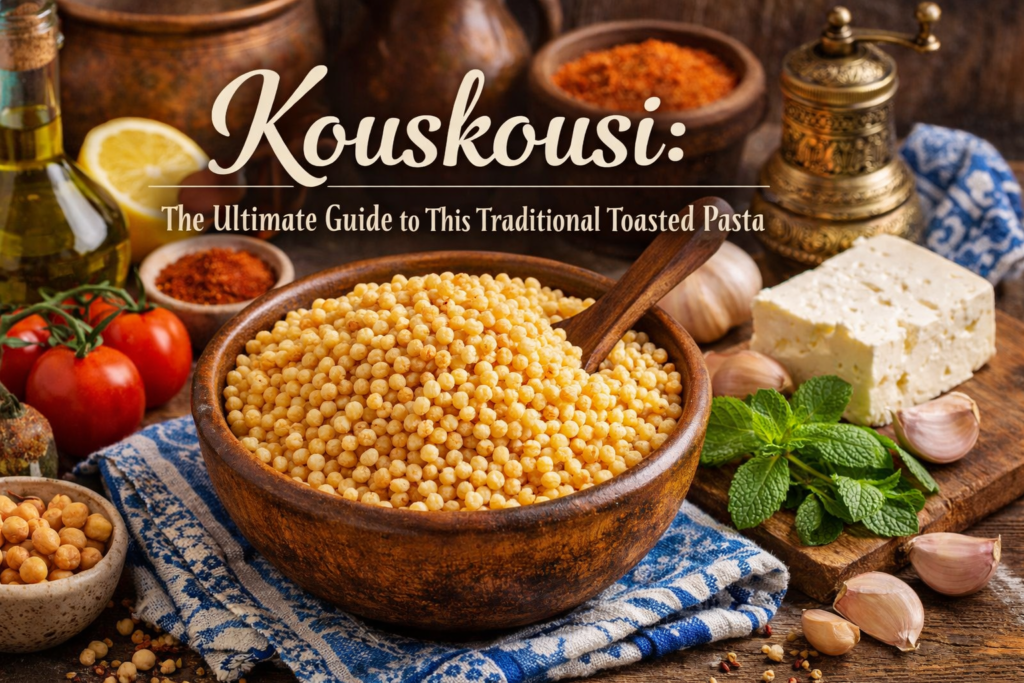

If you’ve ever sat down at a Mediterranean or North African table, you’ve likely seen it—a mountain of golden, fluffy granules acting as the perfect bed for savoury stews. Kouskousi (often used interchangeably with couscous or the Greek kouskous) is far more than a simple side dish. It is a technical marvel of culinary engineering that has survived centuries.
What exactly is Kouskousi? Kouskousi is a traditional Mediterranean and North African staple made from rolled granules of durum wheat semolina. Unlike rice or quinoa, it is technically a form of pasta. It is prepared by steaming rather than boiling, resulting in a light, airy texture that absorbs the flavours of accompanying broths and spices.
Understanding Kouskousi: More Than Just a “Grain”
Let’s be real: most people think they are eating a whole grain when they scoop Kouskousi onto their plate. They aren’t.
The Semantic Debate: Is it Pasta or Semolina?
Here’s the thing—Kouskousi is semolina that has been rubbed with water until it forms tiny pellets, then dusted with fine flour to keep them separate. In the world of culinary taxonomy, this makes it a “rolled pasta.” It doesn’t grow on a stalk; it’s crafted by hand or machine. This distinction matters because it changes everything about how the starch reacts to heat.
Kouskousi vs. Couscous: Clearing the Linguistic Confusion
To be honest, the spelling often depends on where you are standing. In North Africa, it’s the heart of the Maghreb. In Greece, specifically Thrace and the North, “Kouskousi” refers to a slightly larger, pearl-like pasta often made with milk and eggs. While the names are cousins, the Greek version is richer and more “toothy” compared to the ethereal lightness of the Moroccan variety.
The Historical Odyssey: From the Maghreb to the Mediterranean
The story of Kouskousi is a story of survival.
Ancient Berber Roots and the Evolution of the “Rolling” Technique
Evidence suggests that the Berber people of North Africa were rolling these granules as early as the 11th century. Why? Because it was portable. You could dry it, bag it, and take it across the Sahara. It didn’t spoil. It was the original “instant” food, though the traditional preparation was anything but fast.
The Greek Connection: How Kouskousi Became a Thracian Staple
Through trade and migration, these techniques moved. When it hit Greek soil, it transformed. Greek Kouskousi became a labour of love for village women who would spend days rolling dough during the dry summer months, letting the sun do the work of preserving the pasta for the winter ahead.
The Science of Texture: Why Steaming is Non-Negotiable
If you are boiling your Kouskousi in a pot of water like 99-cent macaroni, you are doing it wrong. Stop.
The Traditional Two-Stage Steaming Process
True Kouskousi requires a couscoussier. The bottom pot simmers a rich stew, while the top perforated pot holds the granules. The steam rises, gently swelling the grains without drowning them. Usually, this happens in two or three stages, with the cook removing the Kouskousi to rake it with olive oil or butter between each steam.
Why Boiling Destroys the “Al Dente” Integrity
Boiling turns the granules into a gummy, cohesive mass. You lose the “bead” sensation on the tongue. Steaming preserves the individual integrity of every single tiny pellet.
Pro-Tip: My Personal Take
From my experience auditing culinary content and spending time in professional kitchens, the biggest mistake people make isn’t the water ratio—it’s the “fluffing” timing. Never use a spoon. Use a wide-pronged fork or, if you can handle the heat, your fingertips. I’ve found that rubbing a tablespoon of clarified butter (ghee) into the dry granules before the first steam creates a fat barrier that guarantees 0% clumping. It’s a game-changer for that “cloud-like” texture.
Information Gain: The 2026 Modern Kitchen Shift
The culinary landscape in 2026 has moved beyond the “instant” boxes found in the 2010s. We are seeing a massive return to heritage.
The Rise of “Ancient Grain” Kouskousi
Health-conscious diners are now demanding Kouskousi made from Einkorn and Emmer wheat. These ancient grains have a different gluten structure that many find easier to digest. They also offer a nuttier, more complex flavor profile that makes standard white semolina taste bland by comparison.
Precision Cooking: Using Steam-Ovens and Modern Tech
We’ve moved past the stovetop. In 2026, many home cooks are using “Combi-Steam” ovens. By setting the humidity to exactly 100% at 212°F, you can replicate the traditional couscoussier method with surgical precision, ensuring every grain is hydrated but none are soggy.
Nutritional Breakdown: Is Kouskousi a “Superfood”?
It’s not quite a kale smoothie, but it holds its own.
Protein Content and the Glycemic Index Reality
Kouskousi is surprisingly high in protein for a pasta-adjacent food. However, because it is made from durum wheat, it has a lower Glycemic Index (GI) than white bread. This means slower energy release and fewer insulin spikes.
Micro-nutrients: Selenium, Manganese, and Heart Health
One cup of Kouskousi provides about 60% of your daily recommended intake of Selenium. This is a powerful antioxidant that helps repair damaged cells and reduces inflammation. It’s “heart-smart” soul food.
Regional Masterpieces: How the World Eats Kouskousi
- The Savoury Seven-Vegetable Classic (Morocco): The gold standard. Carrots, chickpeas, pumpkin, and meat are served in a communal dish.
- The Seafood Infusion (Sicily): Known as Couscous alla Trapanese, this version uses a spiced fish broth that smells like the Mediterranean sea.
- Dessert Variations: In some cultures, Kouskousi is served with cinnamon, orange blossom water, and toasted almonds as a light post-dinner treat.
Information Gain: Sustainability & Ethical Sourcing
In 2026, the way your food is grown matters as much as the taste.
Regenerative Agriculture
Top-tier Kouskousi brands are now sourcing from farms that use regenerative tilling practices. This helps sequester carbon in the soil. When you buy “Regen-Certified” Kouskousi, you’re literally helping the planet.
Checking Your Labels: How to spot “Fake” vs. Artisanal
If the ingredients list includes “pre-cooked semolina,” it’s high-heat processed and loses most of its soul. Look for “sun-dried” or “hand-rolled” labels. The texture difference is like comparing a fresh baguette to a slice of toasted cardboard.
Buying & Storing: Professional Secrets
Kouskousi is hardy, but it’s not invincible. Store your dry Kouskousi in an airtight glass jar in a cool, dark place. If you can, use an oxygen-absorber packet. This prevents the natural oils in the wheat from going rancid, keeping it fresh for up to 24 months.
Read about: Levapioli: The Secret Balkan Meat Dish
Frequently Asked Questions About Kouskousi
Is Kouskousi the same as Israeli Pearl Couscous?
No. Israeli “Couscous” (Ptitim) is toasted and much larger. It’s closer to a traditional pasta in texture and shouldn’t be steamed like the fine-grain Kouskousi.
Can I make Kouskousi gluten-free in 2026?
Absolutely. While traditional Kouskousi is wheat-based, 2026 has seen a surge in high-quality cassava and fonio-based “kouskousi” that mimics the texture perfectly without the gluten.
What is the best liquid-to-grain ratio for Kouskousi?
For the “quick” method, use a 1:1 ratio. For the “expert” steaming method, the liquid is in the bottom pot, so the ratio is less about measurement and more about timing (usually 20 minutes per steam).
Why does my Kouskousi turn out mushy?
You likely over-hydrated it or let it sit in the water too long. Kouskousi needs to breathe. Fluff it immediately after cooking to release the trapped steam.
The Verdict: Why Kouskousi Still Rules the Modern Plate
Kouskousi is the ultimate culinary canvas. It’s fast enough for a Tuesday night dinner but deep enough in history to anchor a wedding feast. Whether you’re chasing the 2026 trend of ancient grains or sticking to the hand-rolled traditions of North Africa, this “grain that isn’t a grain” remains a masterpiece of human ingenuity.
To be honest, once you stop boiling it and start respecting the steam, there’s no going back.